Amplifier Type Explained: What It Means for Subwoofers
As an Amazon Associate we earn from qualifying purchases. Links on this page are affiliate links.
Amplifier Type Explained for Subwoofers
When you shop for a subwoofer, the amplifier type explained in product listings tells you how the unit powers the driver. Most modern subs use Class-D amplifiers. You will also see them labeled as digital amplifiers. These terms are often used interchangeably in specifications.
Class-D technology works by switching the output transistors on and off rapidly. This method is highly efficient compared to older analog designs. The switching happens at a frequency much higher than human hearing. The result is less wasted energy and reduced heat generation. Because they run cooler, these amplifiers can be smaller and lighter. This allows manufacturers to build compact subwoofers that still deliver high power.
You will typically find this spec listed under "Amplifier Type" or "Amplifier Class." Look for values like Class-D or Digital. Some listings may simply say "built-in amplifier" without specifying the class. In those cases, check the power consumption or efficiency ratings to infer the technology. Higher efficiency usually points to a Class-D design.
Why does this matter to you? Efficiency translates directly to performance and reliability. A Class-D amplifier converts more electrical power into sound. It draws less current from your outlet. This reduces strain on your home’s electrical system. It also means the unit stays cool during long listening sessions. You get consistent bass output without thermal throttling.
Another benefit is size. Because the components are smaller, you can fit more power into a smaller cabinet. This is crucial for home theater setups where space is limited. You can place the subwoofer in a corner or under a desk without it dominating the room.
When comparing models, prioritize the amplifier type alongside wattage. A higher wattage Class-D amp often outperforms a lower wattage Class-AB amp. Check the total harmonic distortion specs as well. This ensures the amplifier delivers clean, accurate bass. Avoid units with vague amplifier descriptions. Clear specifications help you make an informed choice. Focus on efficiency and heat management for long-term satisfaction.
Class-D vs Digital Amplifier Subwoofers
Class-D
Class-D amplifiers use pulse-width modulation to switch power transistors on and off rapidly. This design offers high efficiency, often exceeding 90 percent, which reduces heat and energy waste. You get more power from a smaller, lighter unit. Polk Monitor XT10 uses a 100W Class-D amp in a compact 11.9-inch width. Dayton Audio CS1200 pairs 200W Class-D power with a 12-inch driver for deep bass. JinYeZi R10 fits a 10-inch Class-D amp under a seat. These subs are ideal for space-constrained rooms or installations where heat dissipation is difficult. The trade-off is potential switching noise, though modern designs minimize this. You benefit from cooler operation and lower power draw compared to older amplifier types.
Digital Amplifier
Digital amplifiers process audio signals using digital-to-analog conversion before amplification. This allows for precise tuning and correction of driver imperfections via internal DSP. Klipsch R-100SW features a digital amplifier for tight, controlled bass in a 12.5-inch wide cabinet. Klipsch Sub-120 uses a digital amp for high dynamic power in a larger 17.7-inch wide unit. Klipsch R-101SW integrates digital processing for accurate bass blending with main speakers. These subs suit home theater setups where precise phase alignment and frequency response are critical. The digital processing can compensate for room modes. However, the complexity may add cost. You get refined sound quality and flexibility in placement, but the unit may be larger due to internal processing components and heat management needs.
Class-D Amplifiers: Who Needs Them
Who needs it
You need a Class-D or digital amplifier if space is tight or efficiency matters. These units deliver high power with minimal heat generation. The efficiency often exceeds 90 percent, meaning less energy waste. You get more output from a smaller chassis. This makes them ideal for compact home theater setups where cabinet size is limited. If you plan to run the subwoofer for long sessions, the reduced thermal output ensures stable performance. You also benefit from lighter weight, which simplifies placement. For those who value modern engineering and reliable power delivery without bulky transformers, this amplifier type is the practical choice. It supports consistent bass response in smaller enclosures.
Who can skip it
You can ignore amplifier type if you prioritize raw power over efficiency. Large, vented enclosures with traditional Class-AB amplifiers may suit you better. These older designs are simpler to understand and repair. If you have ample space and do not mind higher heat output, the efficiency gains of Class-D are less critical. You might prefer the analog signal path of non-digital amps for specific tonal preferences, though data on sound quality differences is limited. Focus on driver size, enclosure volume, and frequency response instead. These specs define bass depth and accuracy more directly than the amplifier class. If you are building a large, dedicated audio room, the size and weight savings of digital amps offer little advantage. Prioritize acoustic performance metrics over power supply design.
Amplifier Glossary Basics
Class-D
A digital amplifier design that uses pulse-width modulation. It offers high efficiency, often over 90 percent, and generates less heat than older analog types.
Digital Amplifier
Another name for Class-D technology. It converts audio signals into digital pulses to drive the speaker, saving energy and reducing the physical size of the unit.
Pulse-Width Modulation
The method used by Class-D amps to control power. It switches transistors on and off rapidly, allowing precise control over the speaker driver with minimal energy loss.
Impedance
The electrical resistance of the speaker coil, measured in ohms. Common values are 4 or 8 ohms. Lower impedance draws more current, affecting how the amplifier performs.
Woofer Size
The diameter of the main speaker driver, usually measured in inches. Larger sizes, like 12 inches, generally move more air to produce deeper bass frequencies.
Enclosure Type
The box design housing the driver. Sealed boxes offer tight control, while ported designs use a vent to boost output at specific low frequencies.
Connectivity
The input options for your audio source. Common types include high-level speaker wires or low-level RCA cables. This determines how the subwoofer receives its signal.
Application
The intended use case for the subwoofer. It might be for home theater surround sound or for high-fidelity music listening. This guides your choice of power and size.
Quick picks
Our 6 picks

Polk Monitor XT10 10" 100W Class-D Subwoofer
Best for: immersive home theater setups with space constraints
- Amplifier Type
- Class-D (what this guide is about)
- Woofer Size
- 10"
- Power Handling
- 100W
- Frequency Response
- 24 Hz
- Connectivity
- Line level, LFE
- Dimensions
- 16.6 × 11.9 × 15.7 inches
View on Amazon: Polk Monitor XT10 10" 100W Class-D Subwoofer Affiliate link
The Polk Monitor XT10 uses a 100W Class-D amplifier to drive a 10-inch woofer. It reaches frequencies as low as 24 Hz for deep bass. The down-firing design helps isolate sound. You get volume, crossover, and phase controls. It supports Dolby Atmos and DTS:X via line level and LFE inputs. This model suits home theater setups needing precise, powerful low-end response.
Pros
- 100W Class-D amplifier delivers loud bass down to 24 Hz
- Down-firing woofer minimizes resonances in a rigid cabinet
- Compatible with Dolby Atmos, DTS:X, and Auro 3D
- Includes volume, variable crossover, and phase polarity controls
Cons
- 10-inch woofer is smaller than the 12-inch options in this guide
- Down-firing design requires specific placement for optimal performance
- Only supports wired line level and LFE connections
Good fit if
- You want a 10-inch subwoofer with a Class-D amplifier
- You need support for Dolby Atmos and DTS:X formats
- You prefer a down-firing design to save floor space
Skip if
- You require wireless connectivity for easy setup
- You need a 12-inch woofer for maximum low-end extension
- You want a front-firing subwoofer for easier placement
Verdict: Polk Monitor XT10 10" Subwoofer delivers efficient Class-D power in a compact, down-firing cabinet. It fits buyers who prioritize immersive format support and precise control over raw size.

Klipsch 10-inch Subwoofer with Digital Amplifier
Best for: small rooms needing tight, controlled bass
- Amplifier Type
- Digital Amplifier (what this guide is about)
- Woofer Size
- 10"
- Power Handling
- 150W continuous, 300W peak
- Enclosure Type
- Front-firing
- Frequency Response
- 32Hz - 120Hz - 3dB
- Connectivity
- Line level LFE RCA
View on Amazon: Klipsch 10-inch Subwoofer with Digital Amplifier Affiliate link
This Klipsch subwoofer uses a digital amplifier to drive a 10-inch front-firing spun-copper IMG woofer. It delivers 150 watts of continuous power and 300 watts peak. The unit covers 32 Hz to 120 Hz. You get line-level LFE RCA inputs for receiver compatibility. Volume, low-pass crossover, and phase controls let you tune the bass. It measures 14.5 by 12.5 by 16.4 inches and weighs 26 pounds.
Pros
- 10-inch front-firing spun-copper IMG woofer
- 300 watts peak digital amplifier power
- Line level LFE RCA inputs
- Phase control with 0 to 180 degree adjustment
- Frequency response down to 32 Hz
Cons
- 10-inch woofer is smaller than the 12-inch options in this list
- 150 watts continuous power is lower than the 200 watts found in other models
- 12.5-inch width is narrower than the 14.5-inch depth of some competitors
Good fit if
- You need a compact subwoofer that fits in tight spaces
- You want a front-firing driver for easy placement near walls
- You prefer a digital amplifier for efficient power handling
Skip if
- You require deep bass below 32 Hz
- You need more than 150 watts of continuous power
- You prefer a 12-inch or larger woofer size
Verdict: Klipsch R-100SW 10" Digital Subwoofer offers precise tuning and compact dimensions for listeners who prioritize space efficiency over maximum low-end extension.

Dayton Audio Classic 12" 200W Powered Subwoofer
Best for: home theater setups needing deep bass
- Amplifier Type
- Class-D (what this guide is about)
- Woofer Size
- 12"
- Power Handling
- 200W
- Connectivity
- Stereo RCA, LFE, speaker-level
- Application
- Home Theater
- Speaker Type
- Powered
View on Amazon: Dayton Audio Classic 12" 200W Powered Subwoofer Affiliate link
The Dayton Audio CS1200 is a 12-inch powered subwoofer featuring a 200W Class-D amplifier. It includes stereo RCA, LFE, and speaker-level inputs for flexible connectivity. The rigid, braced cabinet aims for tight bass without distortion. This model suits home theater setups where you need deep bass integration with existing speakers. The wood grain finish allows it to blend into living spaces.
Pros
- 12-inch woofer for deep bass output
- 200W Class-D amplifier for clean power
- Multiple inputs including RCA, LFE, and speaker-level
- Rigid, braced cabinet reduces distortion
- 5-year warranty for long-term reliability
Cons
- Black grille sold separately, gray included
- No Bluetooth or app connectivity listed
- Larger footprint at 18 inches deep
Good fit if
- You want a 12-inch subwoofer for home theater
- You need multiple input options for your receiver
- You prefer a wood finish for your room
Skip if
- You need Bluetooth connectivity for wireless streaming
- You require a compact under-seat design
- You prefer a black grille included in the box
Verdict: Dayton Audio CS1200 12in Powered Subwoofer delivers solid 12-inch bass with a 200W Class-D amp. It fits home theater users who value wired connectivity and a wood finish.

Klipsch Synergy Black Label Sub-120 12" Subwoofer
Best for: home theater setups needing high dynamic power
- Amplifier Type
- Digital Amplifier (what this guide is about)
- Woofer Size
- 12"
- Enclosure Type
- Front-firing
- Application
- Home Theater
- Size
- Single
- Dimensions
- 23.7 × 17.7 × 21.3 inches
View on Amazon: Klipsch Synergy Black Label Sub-120 12" Subwoofer Affiliate link
The Klipsch Sub-120 features a 12-inch front-firing driver powered by a digital amplifier. It delivers 200 watts of continuous and 400 watts of dynamic power. The spun copper Cerametallic woofers provide detailed bass response. This unit is designed for home theater integration. You can connect it to almost any AV receiver. The black finish allows it to blend into various decor styles easily.
Pros
- 12-inch front-firing driver with spun copper Cerametallic woofers
- 200 watts continuous and 400 watts dynamic power output
- Digital amplifier type for efficient performance
- Compatible with almost any AV receiver
Cons
- Connection wires are not included in the box
- No variable phase or crossover controls listed in specifications
- Single driver configuration limits low-frequency extension compared to dual-driver models
Good fit if
- You want a front-firing subwoofer with strong dynamic power
- You need a unit compatible with standard AV receivers
- You prefer a contemporary black finish for your home theater
Skip if
- You require included connection wires for immediate setup
- You need a subwoofer with variable phase or crossover controls
- You prefer a rear-firing enclosure design
Verdict: Klipsch Sub-120 12" Front-Firing Subwoofer delivers robust dynamic power for home theater enthusiasts who prioritize front-firing design and receiver compatibility. It suits buyers seeking a straightforward digital amplifier solution with high output capabilities.
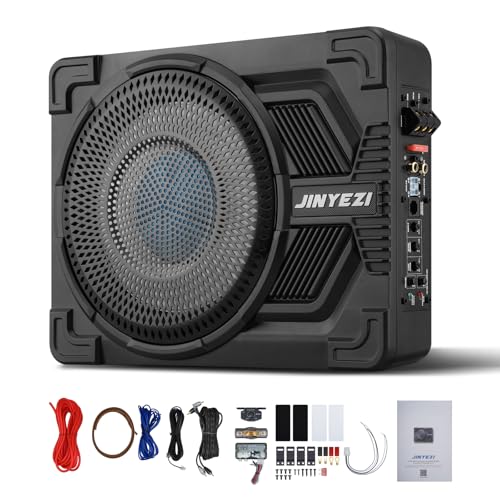
JinYeZi 10" Under-Seat Subwoofer with Class-D Amp
Best for: tight spaces and factory head units
- Amplifier Type
- Class-D (what this guide is about)
- Woofer Size
- 10"
- Power Handling
- 280W RMS, 1200W peak
- Frequency Response
- 20Hz-180Hz
- Impedance
- 2 ohms
- Connectivity
- RCA, high-level, low-level
View on Amazon: JinYeZi 10" Under-Seat Subwoofer with Class-D Amp Affiliate link
This under-seat subwoofer uses a Class D digital amplifier with IRS2092 and IRF540 components. It delivers 280W RMS into a 2-ohm load with a 20Hz to 180Hz frequency response. The thickened aluminum chassis aids heat dissipation and reduces resonance. You get high-level and RCA inputs with a built-in converter. This design fits tight spaces while maintaining stable power output for low-frequency reinforcement.
Pros
- 280W RMS power handling at 2 ohms
- High-efficiency Class D amplifier with superior noise immunity
- Built-in high-to-low level converter for factory head units
- Thickened aluminum chassis for better heat dissipation
Cons
- Low-level input sensitivity is only 100mV
- 2-ohm impedance may require specific amplifier compatibility
- Dimensions are 13.38 x 10.03 x 3 inches
Good fit if
- You need a subwoofer that fits under a seat
- You want a Class D amplifier with high efficiency
- Your vehicle has a factory head unit without RCA outputs
Skip if
- You require a standard 4-ohm impedance for easier integration
- You need a subwoofer larger than 10 inches
- You prefer a sealed enclosure with a different form factor
Verdict: JinYeZi 10" Under-Seat Class D Subwoofer is a compact solution for tight spaces. It suits drivers who prioritize efficiency and factory integration over maximum output.

Klipsch Reference R-101SW 10" Subwoofer
Best for: Home theater setups seeking accurate digital bass
- Amplifier Type
- Digital Amplifier (what this guide is about)
- Woofer Size
- 10"
- Enclosure Type
- front-firing
- Connectivity
- Line/LFE inputs
- Application
- Home Theater
- Dimensions
- 19.7 × 14 × 14.6 inches
View on Amazon: Klipsch Reference R-101SW 10" Subwoofer Affiliate link
The Klipsch R-101SW features a 10-inch spun-copper thermoformed crystalline polymer woofer paired with an all-digital amplifier. This front-firing design delivers deep bass with high efficiency and true-to-source accuracy. It includes low-pass crossover and phase control to blend seamlessly with other speakers. With Line/LFE inputs, it connects easily to your AV receiver. This subwoofer suits home theater setups seeking precise, efficient bass output.
Pros
- 10-inch spun-copper thermoformed crystalline polymer woofer for low distortion
- All-digital amplifier ensures high efficiency and accurate reproduction
- Front-firing driver allows for flexible room placement
- Low-pass crossover and phase control for precise blending
- Line/LFE inputs ensure compatibility with AV receivers
Cons
- 10-inch driver is smaller than the 12-inch options available
- No remote control included for volume or crossover adjustments
- Weight of 30 pounds makes it less portable than lighter models
Good fit if
- You want a front-firing subwoofer for flexible placement
- You value high-efficiency digital amplification for accurate bass
- You need Line/LFE inputs for easy AV receiver connection
Skip if
- You prefer a 12-inch woofer for maximum low-end output
- You need a remote control for convenient adjustments
- You require a lighter subwoofer for easy portability
Verdict: Klipsch R-101SW 10-Inch Digital Subwoofer is a solid choice for home theater enthusiasts who prioritize efficient, accurate bass reproduction. It fits buyers who value precise blending with existing speakers and flexible placement options.
Specifications side by side
| Spec | Polk Monitor XT10 10" 100W Class-D Subwoofer | Klipsch 10-inch Subwoofer with Digital Amplifier | Dayton Audio Classic 12" 200W Powered Subwoofer | Klipsch Synergy Black Label Sub-120 12" Subwoofer | JinYeZi 10" Under-Seat Subwoofer with Class-D Amp | Klipsch Reference R-101SW 10" Subwoofer |
|---|---|---|---|---|---|---|
| Woofer Size | 10" | 10" | 12" | 12" | 10" | 10" |
| Power Handling | 100W | 150W continuous, 300W peak | 200W | not stated | 280W RMS, 1200W peak | not stated |
| Amplifier Type | Built-in Class D | All-digital | Class-D | Digital amplifier | Class D | all-digital |
| Enclosure Type | not stated | Front-firing | not stated | Front-firing | not stated | front-firing |
| Frequency Response | 24 Hz | 32Hz - 120Hz - 3dB | not stated | not stated | 20Hz-180Hz | not stated |
| Impedance | not stated | not stated | not stated | not stated | 2 ohms | not stated |
| Connectivity | Line level, LFE | Line level LFE RCA | Stereo RCA, LFE, speaker-level | not stated | RCA, high-level, low-level | Line/LFE inputs |
| Application | not stated | not stated | Home Theater | Home Theater | not stated | Home Theater |
| Speaker Type | not stated | not stated | Powered | not stated | not stated | not stated |
| Size | not stated | 17.00 | 12in | Single | 10 Inch | 10” Woofer |
| Dimensions | 16.6 × 11.9 × 15.7 inches | 16.9 × 12.5 × 14.8 inches | 18 × 15.5 × 16.4 inches | 23.7 × 17.7 × 21.3 inches | 12.7 × 19.7 × 4.37 inches | 19.7 × 14 × 14.6 inches |
| Weight | 27.3 pounds | 26 pounds | not stated | 36.4 pounds | not stated | 30 pounds |
| Color | Black (vinyl) | Black | Wood | Black | Black | Black |
| Model | MXT10 | R-100SW | CS1200-Wood | eggreh-355 | R10 | R-101SW |
Frequently asked questions
What is the difference between Class-D and digital amplifier subwoofers?
There is no technical difference. Class-D amplifiers use pulse-width modulation to switch power transistors rapidly. Digital amplifier is simply another name for this same technology. You will see both terms used interchangeably in product listings. Both designs offer high efficiency and compact size compared to older analog amplifiers.
Do Class-D subwoofers get hot during use?
They run significantly cooler than older amplifier types. The high efficiency, often exceeding 90 percent, means less energy is wasted as heat. This allows for smaller, lighter cabinets. For example, the Polk Monitor XT10 uses Class-D power to fit into compact spaces without excessive thermal buildup.
Can I use a digital amplifier subwoofer in a small room?
Yes, they are ideal for small rooms. The high efficiency allows for precise tuning and tight bass control without requiring massive physical size. The Klipsch R-100SW features a digital amplifier and compact dimensions, making it suitable for listeners who prioritize space efficiency over maximum low-end extension.
Are digital amplifier subwoofers good for home theater?
They are well-suited for home theater setups. These amplifiers provide robust dynamic power and accurate bass reproduction. The Klipsch Sub-120 offers high output capabilities for enthusiasts who prioritize front-firing design. Similarly, the Dayton Audio CS1200 delivers solid 12-inch bass with a 200W Class-D amp for immersive experiences.
What size subwoofer should I choose for tight spaces?
Look for compact models with efficient amplifiers. The JinYeZi 10 Inch Under-Seat Subwoofer is designed specifically for tight spaces and factory head units. It prioritizes efficiency and integration over maximum output. Its small footprint, measuring just 4.37 inches in height, fits easily under seats.
Do Class-D subwoofers require a separate amplifier?
No, they are powered units. The amplifier is built directly into the subwoofer cabinet. You do not need an external receiver or amp. The Dayton Audio CS1200 is a powered subwoofer with a built-in Class-D amp. This simplifies setup by reducing the number of components you need to connect.
Is a digital amplifier subwoofer better than analog?
Digital, or Class-D, amplifiers are generally preferred for modern subwoofers. They offer higher efficiency and generate less heat. This allows for more power from a smaller unit. The Klipsch R-101SW uses a digital amplifier for efficient, accurate bass reproduction. You get precise blending with existing speakers in a compact form.