Edifier vs ELAC: Speakers Compared by Specs
As an Amazon Associate we earn from qualifying purchases. Links on this page are affiliate links.
When comparing the edifier vs ELAC speaker options, you are looking at two distinct bookshelf designs. Both models deliver clear audio for near-field listening. The main difference lies in their power source and driver construction. The Edifier R1280T is an active powered unit with built-in amplification and side controls. The ELAC Debut 3.0 is a passive speaker requiring an external amplifier, featuring larger woofers and specialized tweeters for precise sound dispersion.
Key differences
| Aspect | Edifier R1280T Powered Bookshelf Speakers | ELAC Debut 3.0 5.25-inch Bookshelf Speakers |
|---|---|---|
| Speaker Type | Powered bookshelf | Passive bookshelf |
| Woofer Size | 4 inch | 5.25 inch |
| Tweeter Type | 13mm silk dome | 1” Aluminum Dome |
| Connectivity | AUX (3.5mm/RCA) | Binding posts |
| Enclosure Type | MDF wood | Bass Reflex |
Which one should you choose?
Choose Edifier R1280T Powered Bookshelf Speakers if
- You want a simple setup without needing a separate amplifier
- You prefer direct volume and bass controls on the speaker itself
- You plan to connect devices via AUX cables directly
Choose ELAC Debut 3.0 5.25-inch Bookshelf Speakers if
- You seek larger woofers for deeper low-frequency response
- You already own an amplifier and want passive flexibility
- You prioritize aluminum dome tweeters for high-frequency clarity
Verdict: Choose the Edifier R1280T if you want an all-in-one solution with easy connectivity and compact controls. Select the ELAC Debut 3.0 if you prefer larger drivers and a passive design that integrates with your existing amplifier ecosystem.
Edifier vs ELAC Speaker Specs
woofer size
The Edifier R1280T uses a 4-inch full-range unit for its low and mid frequencies. In contrast, the ELAC Debut 3.0 DB53-BK features a larger 5.25-inch woofer made from woven aramid fiber. This aramid cone material offers greater stiffness and damping compared to standard polypropylene or paper cones. The added strength allows for more flexibility in design, which helps achieve a smoother and extended low-frequency response. The larger driver in the ELAC model generally allows for better bass extension and higher output levels than the smaller 4-inch driver found in the Edifier.
tweeter type
Driver construction differs significantly between these two bookshelf speakers. The Edifier R1280T employs a 13mm silk dome tweeter to handle high frequencies. The ELAC Debut 3.0 utilizes a 1-inch aluminum dome tweeter. This ELAC tweeter is paired with a newly designed waveguide and phase plug. This combination allows for a wider dispersion pattern, ensuring consistent sound across a broader listening area. The aluminum dome aims to reproduce high frequencies with greater clarity and detail, providing a more precise and immersive experience compared to the silk dome approach used by Edifier.
connectivity
Power and connection methods define how you use each speaker. The Edifier R1280T is a powered bookshelf speaker, meaning it has built-in amplification. It features two AUX inputs, allowing you to connect two devices simultaneously via 3.5mm or dual RCA outputs without needing to plug and switch cables. The ELAC Debut 3.0 is a passive speaker, so it requires an external amplifier or receiver to function. While the ELAC is noted as easy to drive and compatible with a wider range of amplifiers, you must provide the power source yourself, unlike the all-in-one Edifier solution.
enclosure type
The cabinet design impacts sound quality and physical footprint. The Edifier R1280T is built from high-quality MDF wood with a wood effect vinyl finish. It includes side panel controls for volume, bass, and treble adjustments on the active speaker. The ELAC Debut 3.0 uses a bass reflex enclosure type. It features internal bracing to significantly enhance performance by reducing unwanted vibrations that can distort sound. This ensures sound is primarily emitted from the drivers rather than the cabinet. The ELAC also includes magnetically attached grilles for a clean, hardware-free look.
size
Physical dimensions affect where you can place these speakers. The Edifier R1280T measures 9.5 inches in width, 5.8 inches in height, and 6.9 inches in length, weighing 10.8 pounds per unit. The ELAC Debut 3.0 DB53-BK is taller and deeper, measuring 8 inches in width, 14 inches in height, and 18 inches in length, with a weight of 13.3 pounds. The ELAC is significantly taller, which may influence placement on shelves or stands. The Edifier is more compact in height and depth, making it potentially easier to fit in tighter spaces.
Choose Your Ideal Bookshelf Speakers
Users wanting simple plug-and-play setup
The Edifier R1280T is a powered bookshelf speaker, meaning it includes built-in amplification. You can connect devices directly via the dual AUX inputs without needing a separate receiver. The remote control lets you adjust volume and EQ from the side panel, offering convenience for direct desktop or near-field listening.
Listeners prioritizing driver material and clarity
The ELAC Debut 3.0 features a 1-inch aluminum dome tweeter and a 5.25-inch woven aramid fiber woofer. This configuration provides precise high-frequency dispersion and greater cone stiffness. The aramid material helps achieve a smoother, extended low-frequency response, delivering clear detail and reduced distortion for audiophile-grade sound.
Those needing efficient passive speaker performance
The ELAC Debut 3.0 is designed to be easy to drive, requiring less power from an amplifier to reach comparable volume levels. Its bass reflex enclosure and internal bracing reduce unwanted vibrations. This efficiency makes it compatible with a wider range of amplifiers while maintaining structural rigidity for cleaner audio output.
The products compared
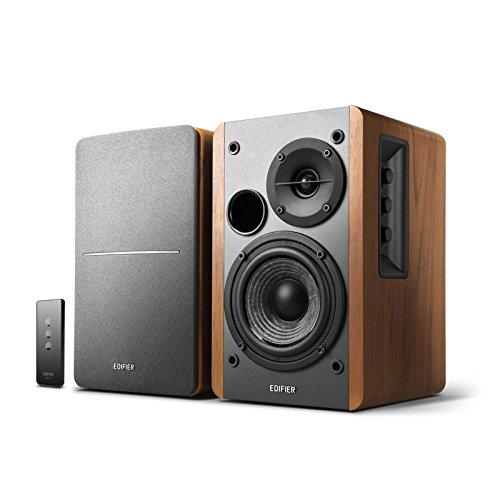
Edifier R1280T Powered Bookshelf Speakers
Best for: Dual wired device connectivity and manual EQ
- Speaker Type
- Powered Bookshelf
- Woofer Size
- 4 inch
- Power Handling
- 42 Watts RMS
- Tweeter Type
- silk dome
- Connectivity
- AUX, RCA
- Dimensions
- 6.9 × 9.5 × 5.8 inches
View on Amazon: Edifier R1280T Powered Bookshelf Speakers Affiliate link
The Edifier R1280T is a 2.0 powered bookshelf speaker designed for near-field studio monitoring. It features a 4-inch woofer and a 13mm silk dome tweeter for natural sound reproduction. You can connect two devices simultaneously via AUX inputs. The unit includes a remote control and side panel knobs for bass and treble adjustments. Its MDF wood build adds a classic finish to your setup.
Pros
- Dual AUX inputs allow simultaneous connection of two devices
- Includes remote control for volume adjustment
- Side panel knobs enable manual bass and treble EQ control
- 4-inch woofer paired with a 13mm silk dome tweeter
Cons
- Lacks Bluetooth wireless connectivity
- No optical or digital input options listed
- Physical controls are located on the speaker rather than the remote
Good fit if
- You need to connect two wired devices at once
- You prefer manual EQ adjustments via physical knobs
- You want a compact powered speaker for near-field listening
Skip if
- You require wireless Bluetooth streaming
- You need optical or digital audio inputs
- You want full control via a remote without touching the speaker
Verdict: Edifier R1280T Powered Bookshelf Speakers suits users who value wired versatility and manual tuning. It is a solid choice for near-field monitoring where dual device connectivity is essential.

ELAC Debut 3.0 5.25-inch Bookshelf Speakers
Best for: listeners seeking detailed sound in compact spaces
- Speaker Type
- Bookshelf Speakers
- Woofer Size
- 5.25 inch
- Configuration
- 2-Way
- Tweeter Type
- 1” Aluminum Dome Tweeter
- Enclosure Type
- Bass Reflex
- Dimensions
- 18 × 8 × 14 inches
View on Amazon: ELAC Debut 3.0 5.25-inch Bookshelf Speakers Affiliate link
The ELAC Debut 3.0 DB53-BK is a pair of 2-way bookshelf speakers featuring a 5.25-inch aramid fiber woofer and a 1-inch aluminum dome tweeter. The bass reflex enclosure and internal bracing reduce cabinet vibration for clearer sound. These speakers are efficient and easy to drive, making them suitable for users seeking precise high-frequency detail and extended low-frequency response in a compact, stylish package.
Pros
- 1-inch aluminum dome tweeter provides high-frequency clarity
- 5.25-inch woven aramid fiber woofer offers stiffness and damping
- Internal bracing reduces unwanted cabinet vibrations
- Efficient design requires less amplifier power
Cons
- 8-inch width may not fit tight spaces
- 13.3-pound weight per speaker requires sturdy mounting
- No remote control included
Good fit if
- You want precise high-frequency detail
- You have a compact amplifier
- You prefer a modern aesthetic
Skip if
- You need wireless connectivity
- You require a subwoofer
- You have very limited shelf space
Verdict: ELAC Debut 3.0 5.25" Bookshelf Speakers deliver clear, detailed sound with efficient power requirements, making them a strong choice for listeners who value audio precision and modern design in a compact form factor.
Specifications side by side
| Spec | Edifier R1280T Powered Bookshelf Speakers | ELAC Debut 3.0 5.25-inch Bookshelf Speakers |
|---|---|---|
| Speaker Type | Powered Bookshelf | Bookshelf Speakers |
| Woofer Size | 4 inch | 5.25 inch |
| Configuration | not stated | 2-Way |
| Power Handling | 42 Watts RMS | not stated |
| Tweeter Type | silk dome | 1” Aluminum Dome Tweeter |
| Connectivity | AUX, RCA | not stated |
| Enclosure Type | not stated | Bass Reflex |
| Ways | not stated | 2-Way |
| Dimensions | 6.9 × 9.5 × 5.8 inches | 18 × 8 × 14 inches |
| Weight | 10.8 pounds | 13.3 pounds |
| Color | wood | Black Ash |
| Model | R1280T | DB53-BK |
| Size | not stated | 5.25" |
Frequently asked questions
Which bookshelf speaker is better for small rooms?
The ELAC Debut 3.0 is often preferred for compact spaces. Its 5.25-inch woofer and 2-way configuration provide detailed sound without overwhelming a small area. The Edifier R1280T is also suitable but has a 4-inch driver. You should consider the ELAC if you prioritize audio precision in a tight footprint.
Do I need an external amplifier for these speakers?
You only need an external amplifier for the ELAC Debut 3.0. It is a passive speaker that requires a separate receiver to function. The Edifier R1280T is a powered bookshelf speaker with built-in amplification. You can connect devices directly to the Edifier without any additional hardware for power.
Can I connect two devices to the Edifier speakers?
Yes, the Edifier R1280T supports dual wired device connectivity. It features dual AUX inputs that allow you to link two sources simultaneously. This setup is ideal for near-field monitoring where you switch between devices frequently. The ELAC Debut 3.0 does not list this specific connectivity feature in its specifications.
What is the weight difference between the two models?
The Edifier R1280T weighs 10.8 pounds per unit. The ELAC Debut 3.0 is heavier at 13.3 pounds per unit. This difference comes from their internal components and cabinet construction. You should ensure your shelves can support the ELAC weight if you plan to place them on standard furniture.
Which speaker has a larger woofer size?
The ELAC Debut 3.0 has a larger woofer size. It uses a 5.25-inch driver for low and mid frequencies. The Edifier R1280T utilizes a smaller 4-inch full-range unit. The larger cone on the ELAC can move more air, which may affect bass response compared to the Edifier's compact design.
Are these speakers available in wood finish?
The Edifier R1280T is available in a wood color finish. This gives it a classic aesthetic for home setups. The ELAC Debut 3.0 is listed in Black Ash. You should choose the Edifier if you prefer a natural wood look over the darker, modern appearance of the ELAC model.
How tall are the ELAC bookshelf speakers?
The ELAC Debut 3.0 speakers are 14 inches in height. They measure 8 inches wide and 18 inches deep. This compact form factor allows them to fit on most standard shelves or stands. The Edifier R1280T is shorter at 5.8 inches high, making it even more suitable for tight spaces.