Rockford Fosgate Punch P3 12-inch DVC Subwoofer vs Rockford Fosgate Punch 10" 2-Ohm Subwoofer: Spec Comparison
As an Amazon Associate we earn from qualifying purchases. Links on this page are affiliate links.
This comparison examines the rockford fosgate p3d4 12 punch p3 dvc vs p3d2 10 punch p3 2 ohm dvc 10. Both models belong to the P3 Series and feature anodized aluminum cones, spider venting, and hybrid stamp-cast baskets. They share dual voice coil designs and 1-year warranties. The main difference lies in their physical dimensions and power handling. The 12-inch model offers higher wattage capacity, while the 10-inch version provides a more compact footprint for tighter installation spaces.
Key differences
| Aspect | Rockford Fosgate Punch P3 12-inch DVC Subwoofer | Rockford Fosgate Punch 10" 2-Ohm Subwoofer |
|---|---|---|
| Woofer Size | 12" | 10" |
| Impedance | 4-Ohm DVC | 2-Ohm DVC |
| Power Handling (RMS) | 600 Watts | 500 Watts |
| Weight | 11.2 pounds | 9.55 pounds |
| Mounting Depth | 6.66 inches | 6.18 inches |
Which one should you choose?
Choose Rockford Fosgate Punch P3 12-inch DVC Subwoofer if
- You need higher RMS power handling for louder bass output.
- You have space for a 12-inch driver and deeper enclosure.
- You prefer a 4-ohm dual voice coil configuration.
Choose Rockford Fosgate Punch 10" 2-Ohm Subwoofer if
- You require a smaller footprint for tight vehicle or cabin spaces.
- You want a lighter subwoofer to reduce overall system weight.
- You plan to wire a 2-ohm dual voice coil setup.
Verdict: Choose the 12-inch model if you prioritize maximum power handling and have the space for a larger driver. Select the 10-inch option if installation constraints demand a smaller diameter and lower weight. Both deliver reference quality bass with identical build materials and venting technology.
P3 12-inch vs P3 10-inch Specs
woofer size
The Rockford Fosgate Punch P3 12-inch DVC Subwoofer features a larger 12-inch cone compared to the 10-inch driver in the Rockford Fosgate Punch 10" 2-Ohm Subwoofer. A larger cone generally moves more air, which can produce deeper bass frequencies with greater physical displacement. This size difference affects how each subwoofer interacts with your listening space and enclosure volume requirements. If you prioritize low-frequency extension and maximum air movement, the 12-inch model offers a physical advantage. The 10-inch unit is more compact, which might suit tighter installation constraints where space is limited.
power handling
Power handling ratings differ between the two models. The 12-inch subwoofer handles 600 Watts RMS and up to 1200 Watts Max. The 10-inch subwoofer is rated for 500 Watts RMS and 1000 Watts Max. Higher RMS power handling suggests the 12-inch driver can sustain more continuous power without damage. This allows for louder volumes and potentially cleaner output at high levels. If your amplifier delivers more power, the 12-inch model provides a larger safety margin. The 10-inch model still offers substantial power handling for most applications, but the 12-inch unit has the edge in raw power capacity.
impedance
Impedance options vary to suit different amplifier configurations. The 12-inch model is a 4-ohm dual voice coil (DVC) subwoofer. The 10-inch model is a 2-ohm DVC subwoofer. Lower impedance allows amplifiers to deliver more current, which can increase power output if the amp is stable at 2 ohms. The 2-ohm 10-inch subwoofer may be easier to drive with certain mono amplifiers or when wiring multiple subs for low impedance loads. The 4-ohm 12-inch subwoofer offers flexibility for amplifiers that prefer higher impedance loads or when wiring for stability. Your amplifier's output impedance determines which is better.
enclosure volume
Recommended enclosure volumes differ significantly due to driver size. The 12-inch subwoofer requires 1.02 cubic feet for sealed enclosures and 1.79 cubic feet for vented designs. The 10-inch subwoofer needs 0.59 cubic feet for sealed and 1.4 cubic feet for vented setups. Larger enclosures are necessary for the 12-inch model to achieve proper tuning and performance. If you have limited space in your vehicle or room, the 10-inch subwoofer allows for smaller box designs. The 12-inch model demands more internal volume, which may impact installation options in compact spaces.
mounting depth
Physical dimensions affect installation depth. The 12-inch subwoofer has a mounting depth of 6.66 inches. The 10-inch subwoofer requires 6.18 inches of depth. Both models have similar overall heights, but the 12-inch unit protrudes slightly more. If you have tight clearance under seats or in cargo areas, the 10-inch model offers a slight advantage with its reduced mounting depth. This difference may be critical in vehicles with shallow enclosure spaces. The 12-inch model requires a bit more room, which could limit placement options in constrained environments.
Which subwoofer suits your needs
You want maximum bass output and headroom
The 12-inch model handles 600 watts RMS and 1200 watts peak. This higher power rating allows for louder playback without distortion. The larger 12-inch cone moves more air than the 10-inch driver, delivering deeper and more impactful low frequencies for music or movies.
You have limited enclosure space available
The 10-inch subwoofer requires a smaller sealed box volume of 0.59 cubic feet compared to 1.02 cubic feet for the 12-inch version. It also has a smaller cutout diameter of 9.13 inches versus 11.25 inches. This makes it easier to fit in compact installations.
You prefer a lighter and more compact driver
The 10-inch unit weighs 9.55 pounds, which is lighter than the 12-inch model at 11.2 pounds. Its overall dimensions are smaller, with a height of 9 inches compared to 10 inches. This reduces the physical footprint and weight load in your vehicle or room.
You need flexibility with amplifier impedance
The 12-inch subwoofer is available in a 4-ohm dual voice coil configuration. This impedance can be wired in series or parallel to match different amplifier outputs. The 4-ohm option provides a stable load for many standard car audio amplifiers while maintaining high power handling.
The products compared
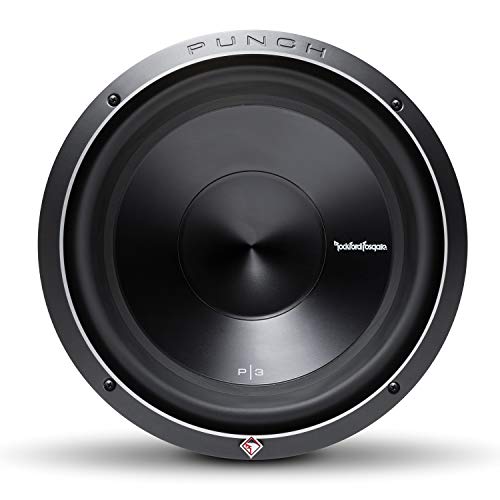
Rockford Fosgate Punch P3 12-inch DVC Subwoofer
Best for: High-power 12-inch sealed or vented builds
- Woofer Size
- 12"
- Power Handling
- 600W RMS / 1200W Max
- Enclosure Type
- Sealed or vented
- Impedance
- 4-ohm DVC
- Dimensions
- 14.5 × 14.5 × 10 inches
- Weight
- 11.2 pounds
View on Amazon: Rockford Fosgate Punch P3 12-inch DVC Subwoofer Affiliate link
The Rockford Fosgate P3D4-12 is a 12-inch dual voice coil subwoofer designed for high-performance bass. It handles 600 watts RMS and 1200 watts peak power. The 4-ohm impedance allows flexible wiring options. It features an anodized aluminum cone and spider venting for cooler operation. This subwoofer suits you if you need a durable driver for sealed or vented enclosures with ample power handling.
Pros
- 12-inch woofer size for deep bass output
- 600W RMS and 1200W Max power handling
- 4-ohm dual voice coil configuration
- Anodized aluminum cones and dustcaps
- Spider venting design for thermal management
Cons
- Heavier at 11.2 pounds compared to smaller models
- Requires a 1.02 to 1.79 cubic foot enclosure
- Standard one-year warranty period
Good fit if
- You need a 12-inch subwoofer with high power handling
- You prefer a 4-ohm dual voice coil for wiring flexibility
- You are building a sealed or vented enclosure system
Skip if
- You require a 10-inch subwoofer for tighter spaces
- You need a 2-ohm impedance for lower resistance wiring
- You want a subwoofer under 10 pounds in weight
Verdict: Rockford Fosgate P3D4-12 12-Inch Subwoofer delivers robust power handling and durable construction for enthusiasts building larger sealed or vented enclosures. It is the right choice if you prioritize the 12-inch driver size and 4-ohm dual voice coil flexibility over compact dimensions.
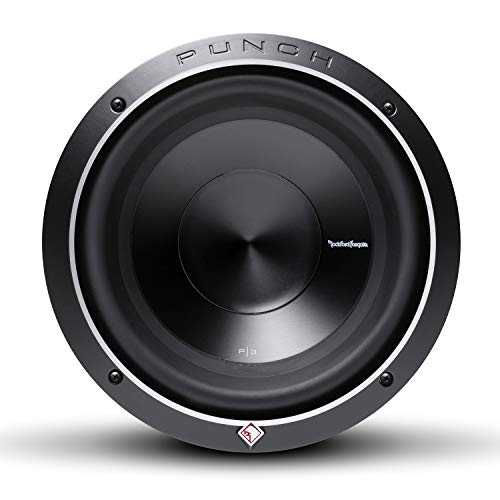
Rockford Fosgate Punch 10" 2-Ohm Subwoofer
Best for: compact enclosures and durable aluminum builds
- Woofer Size
- 10"
- Power Handling
- 500W RMS / 1000W Max
- Enclosure Type
- Sealed or vented
- Impedance
- 2-ohm DVC
- Dimensions
- 12 × 12 × 9 inches
- Weight
- 9.55 pounds
View on Amazon: Rockford Fosgate Punch 10" 2-Ohm Subwoofer Affiliate link
The Rockford Fosgate Punch P3 10-inch 2-Ohm Subwoofer delivers reference quality bass with 500 Watts RMS power handling. It features a 10-inch anodized aluminum cone and dual voice coil design for flexible wiring. The subwoofer weighs 9.55 pounds and fits in sealed enclosures of 0.59 cubic feet or vented boxes of 1.4 cubic feet. It includes a full one-year warranty and custom push terminals for secure connections.
Pros
- 500 Watts RMS power handling for robust output
- Anodized aluminum cone and dustcap for durability
- Spider venting design helps keep the motor cooler
- Hybrid stamp-cast basket minimizes weight and resonance
Cons
- Smaller 10-inch driver compared to the 12-inch competitor
- Lower 500W RMS rating versus the 600W RMS rival
- Heavier at 9.55 pounds due to robust basket construction
Good fit if
- You need a compact subwoofer for smaller enclosures
- You prefer a 2-Ohm dual voice coil configuration
- You want a durable build with aluminum components
Skip if
- You require higher power handling than 500 Watts RMS
- You need a larger 12-inch driver for maximum displacement
- You prefer a lighter subwoofer under 9 pounds
Verdict: Rockford Fosgate Punch P3 10-inch 2-Ohm Subwoofer suits you if you prioritize compact size and durable aluminum construction over raw power output. It is a solid choice for tight spaces where a 10-inch driver fits better than a larger alternative.
Specifications side by side
| Spec | Rockford Fosgate Punch P3 12-inch DVC Subwoofer | Rockford Fosgate Punch 10" 2-Ohm Subwoofer |
|---|---|---|
| Woofer Size | 12" | 10" |
| Power Handling | 600W RMS / 1200W Max | 500W RMS / 1000W Max |
| Enclosure Type | Sealed or vented | Sealed or vented |
| Impedance | 4-ohm DVC | 2-ohm DVC |
| Dimensions | 14.5 × 14.5 × 10 inches | 12 × 12 × 9 inches |
| Weight | 11.2 pounds | 9.55 pounds |
| Size | 12" | 10" |
| Color | Black | Black |
| Model | P3D4-12 | P3D2-10 |
Frequently asked questions
Which subwoofer has the larger physical dimensions?
The Rockford Fosgate Punch P3 12-inch DVC Subwoofer is larger. It measures 14.5 inches in width and length with a height of 10 inches. The 10-inch model is more compact, measuring 12 inches wide and long, with a height of 9 inches. Choose the 12-inch if you have ample space for a bigger enclosure.
Which model weighs less?
The 10-inch Rockford Fosgate Punch Subwoofer is lighter. It weighs 9.55 pounds. The 12-inch DVC version weighs 11.2 pounds. The lighter weight of the smaller driver may simplify installation in tight vehicle spaces or lightweight enclosures where every pound matters.
What is the impedance difference between these two models?
The 12-inch model features a 4-ohm dual voice coil configuration. The 10-inch model uses a 2-ohm dual voice coil design. This difference affects how you wire the subwoofer to your amplifier. A 4-ohm coil offers more wiring flexibility for certain amp setups compared to a 2-ohm coil.
Which subwoofer is better for compact enclosures?
The 10-inch Rockford Fosgate Punch Subwoofer is better for compact builds. Its smaller footprint, measuring 12 inches square, fits into tighter spaces. The 12-inch model requires more room due to its 14.5-inch dimensions. If you are limited on enclosure volume, the 10-inch driver is the practical choice.
Do both models share the same color finish?
Yes, both subwoofers feature a black finish. The Rockford Fosgate Punch P3 12-inch DVC and the 10-inch 2-Ohm version both come in black. This consistent aesthetic ensures they match well within the same audio system or vehicle interior without visual contrast issues.
Which model is the top pick for high-power builds?
The 12-inch Rockford Fosgate Punch P3 DVC is the top pick for high-power applications. It is designed for robust power handling and durable construction. This model suits enthusiasts building larger sealed or vented enclosures. If you prioritize raw output and driver size, the 12-inch version is the recommended selection.