Sundown Audio E Series v.4 12" vs Sundown Audio SA-10 Classic 10" Subwoofer: Spec Comparison
As an Amazon Associate we earn from qualifying purchases. Links on this page are affiliate links.
When comparing the sundown audio e series v 4 12 d4 car subwoofer vs sa 10 classic series, you see two high-performance drivers from Sundown Audio. Both are built for car audio systems and feature robust construction with high-temperature voice coils. The main difference lies in their size and power handling. The E Series v.4 offers a larger 12-inch cone and higher peak power, while the SA-10 Classic provides a more compact 10-inch design with greater RMS power tolerance. Your choice depends on enclosure space and desired bass output.
Key differences
| Aspect | Sundown Audio E Series v.4 12" D4 | Sundown Audio SA-10 Classic 10" Subwoofer |
|---|---|---|
| Woofer Size | 12" | 10" |
| Power Handling (RMS) | 750W | 1000W |
| Power Handling (Peak) | 1500W | 2000W |
| Impedance | Dual 4-ohm | Dual 2-ohm |
| Enclosure Optimization | Ported | Ported, Sealed, Band-pass |
| Xmax (Excursion) | 14mm | 19mm |
Which one should you choose?
Choose Sundown Audio E Series v.4 12" D4 if
- You need a subwoofer optimized specifically for ported enclosures to maximize efficiency.
- You prefer a larger 12-inch cone for deeper low-frequency extension.
- You have a dual 4-ohm amplifier configuration or prefer higher impedance for stability.
Choose Sundown Audio SA-10 Classic 10" Subwoofer if
- You require higher continuous power handling with 1000W RMS for sustained output.
- You need versatility to use the sub in sealed, ported, or band-pass boxes.
- You want greater linear excursion with a 19mm Xmax for high SPL performance.
Verdict: Choose the E Series v.4 if you prioritize a larger 12-inch driver and a dedicated ported enclosure design for deep bass. Select the SA-10 Classic if you need higher RMS power handling, greater enclosure flexibility, and more excursion for high-output applications.
E Series v.4 vs SA-10 Specs
woofer size
The Sundown Audio E Series v.4 12" D4 features a 12-inch cone, while the SA-10 Classic is a 10-inch model. A larger cone generally moves more air, which can translate to deeper bass extension and higher output levels in the low frequencies. The 12-inch driver in the E Series is designed to deliver impactful low-frequency performance with its class-leading 14mm Xmax. The 10-inch SA-10 offers a more compact footprint but still provides robust power handling. You should choose the 12-inch version if you prioritize maximum displacement and deep rumble, or the 10-inch if space is limited.
power handling
Power ratings differ between these two drivers. The SA-10 Classic handles 1000 Watts RMS and 2000 Watts Peak. The E Series v.4 12" is rated for 750 Watts RMS and 1500 Watts Peak. The SA-10 has a higher continuous power handling capacity, which may allow it to sustain high volumes for longer periods without damage. The E Series focuses on excursion efficiency rather than raw power limits. If your amplifier delivers higher continuous wattage, the SA-10 might be more suitable. However, both are built for high-performance car audio applications with durable components.
impedance
Impedance affects how your amplifier loads the subwoofer. The E Series v.4 12" is available as a Dual 4-ohm model, as listed in the provided data. The SA-10 Classic is available in a Dual 2-ohm configuration. A Dual 2-ohm subwoofer draws more current from the amplifier, potentially offering more power transfer but requiring an amplifier that can handle lower impedance loads stably. The Dual 4-ohm option is often easier to drive with standard amplifiers. You must ensure your amplifier is compatible with the specific impedance of the subwoofer you select to avoid damage or poor performance.
enclosure type
The E Series v.4 is specifically optimized for ported enclosures, with recommended net volume of 1.7 cubic feet and a tuning frequency around 35Hz. The SA-10 Classic is more versatile, supporting small ported (1.0 cu ft), sealed (0.5 cu ft), and band-pass setups. The SA-10 offers flexibility for different installation constraints and sound preferences. The E Series requires a ported design to achieve its specified performance characteristics. If you need a subwoofer that can fit into various enclosure types, the SA-10 is the better choice. For dedicated ported builds, the E Series is tailored for that purpose.
excursion
Excursion determines how far the cone moves, impacting bass output. The SA-10 Classic features a deep excursion capability with an Xmax of 19mm. The E Series v.4 12" has a 14mm one-way linear Xmax. The 19mm excursion of the SA-10 allows for greater air movement, which can result in higher sound pressure levels. The E Series achieves deep bass through its optimized motor design and larger cone area. If you prioritize maximum cone travel for SPL performance, the SA-10 has an advantage. The E Series balances excursion with efficiency for its size.
Which subwoofer suits your build
Needs maximum low-frequency extension
The E Series v.4 12" D4 features a 12-inch cone and a resonant frequency of 28.373 Hz. This allows for deeper bass output in ported enclosures. With a 14mm Xmax, it moves significant air. You get impactful low-end response optimized for compact ported boxes with a 1.7 cubic foot net volume.
Prioritizes power handling and versatility
The SA-10 Classic 10" handles 1000 Watts RMS and 2000 Watts Peak. It offers greater enclosure flexibility, supporting sealed, ported, and band-pass setups. Its 19mm Xmax ensures deep excursion. The dual 2-ohm voice coil provides options for amplifier matching. You benefit from a cast aluminum frame and low-distortion motor design.
Wants deep excursion in a 10-inch frame
The SA-10 Classic delivers a 19mm Xmax within a 10-inch chassis. This excursion depth ensures powerful low-frequency output without requiring a larger cone. The 2.5-inch high-temperature voice coil minimates distortion. You get a robust cast aluminum frame and spring-loaded terminals for secure installation. It fits well in smaller sealed or band-pass enclosures.
The products compared

Sundown Audio E Series v.4 12" D4
Best for: Deep bass in ported car enclosures
- Woofer Size
- 12"
- Power Handling
- 750W RMS / 1500W Peak
- Impedance
- Dual 4-ohm
- Application
- Cars
- Enclosure Type
- Ported
- Size
- 12" - Dual 4 Ohm
View on Amazon: Sundown Audio E Series v.4 12" D4 Affiliate link
The Sundown Audio E Series v.4 12" is a car subwoofer designed for ported enclosures. It features a 750W RMS power handling rating and a 14mm Xmax for deep bass. The dual 4-ohm voice coil allows for flexible wiring options. You will appreciate its optimized motor design and durable construction. This unit suits listeners who need high output and deep low-frequency response in a compact package.
Pros
- 750W RMS and 1500W Peak power handling
- 14mm one-way linear Xmax for deep excursion
- Dual 4-ohm voice coil configuration
- Optimized for ported enclosures with 28.373 Hz Fs
- High-temp 4-layer copper voice coil wire
Cons
- Dual 4-ohm impedance limits amp matching options compared to dual 2-ohm models
- Requires specific ported enclosure tuning (35 Hz)
- Physical dimensions require careful fitment in vehicle
Good fit if
- You want deep bass output from a 12-inch driver
- You are building a ported enclosure system
- You need high power handling for loud music
Skip if
- You prefer sealed enclosure designs
- You require a dual 2-ohm voice coil
- You need a subwoofer for home theater use
Verdict: Sundown Audio E Series v.4 12" Subwoofer delivers class-leading excursion and power for car audio enthusiasts. It fits buyers who prioritize deep bass impact and durable construction in a ported setup.
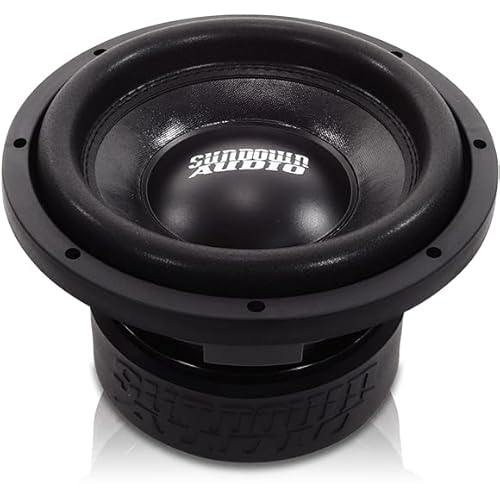
Sundown Audio SA-10 Classic 10" Subwoofer
Best for: small ported car audio installations
- Woofer Size
- 10 inches
- Power Handling
- 1000W RMS / 2000W Peak
- Impedance
- Dual 2 Ohm
- Size
- 10" - Dual 2 Ohm
- Dimensions
- 4 × 5 × 2 inches
View on Amazon: Sundown Audio SA-10 Classic 10" Subwoofer Affiliate link
The Sundown Audio SA-10 Classic is a 10-inch dual 2-ohm subwoofer rated for 1000 watts RMS and 2000 watts peak power. It features a 19mm Xmax for deep excursion and fits in small ported enclosures of 1.0 cubic feet. This unit uses a cast aluminum frame and a 2.5-inch voice coil to minimize distortion. It suits car audio builds requiring high output in compact spaces.
Pros
- 1000W RMS and 2000W Peak power handling
- 19mm Xmax for deep bass excursion
- Optimized for small 1.0 cu ft ported enclosures
- Cast aluminum frame for durability
Cons
- 10-inch size limits low-frequency extension compared to 12-inch models
- Dual 2-ohm impedance requires specific amplifier matching
- Black motor finish may not match all trim styles
Good fit if
- You need high output in a small ported box
- You require a durable cast aluminum frame
- You have a dual 2-ohm amplifier channel
Skip if
- You need a 12-inch driver for deeper bass
- You prefer sealed enclosures under 0.5 cu ft
- You require a single 4-ohm impedance option
Verdict: Sundown Audio SA-10 Classic 10" Subwoofer delivers high power and compact enclosure flexibility for car audio enthusiasts. It fits buyers who prioritize deep excursion and durable construction in a 10-inch format.
Specifications side by side
| Spec | Sundown Audio E Series v.4 12" D4 | Sundown Audio SA-10 Classic 10" Subwoofer |
|---|---|---|
| Woofer Size | 12" | 10 inches |
| Power Handling | 750W RMS / 1500W Peak | 1000W RMS / 2000W Peak |
| Impedance | Dual 4-ohm | Dual 2 Ohm |
| Application | Cars | not stated |
| Enclosure Type | Ported | not stated |
| Size | 12" - Dual 4 Ohm | 10" - Dual 2 Ohm |
| Dimensions | 4 × 5 × 2 inches | 4 × 5 × 2 inches |
| Color | black | black |
| Model | E-12v4D4 | SW-SACL10D2 |
Frequently asked questions
What is the difference in impedance between the two subs?
The E Series v.4 12" D4 has a dual 4-ohm configuration. The SA-10 Classic features a dual 2-ohm setup. This means the 10-inch model presents a lower electrical resistance. You need to check your amplifier’s compatibility to ensure it can handle the dual 2-ohm load safely without overheating.
Do both subwoofers fit in standard car trunks?
Yes, both models share identical physical dimensions. Each measures 5 inches in width, 2 inches in height, and 4 inches in length. Their compact footprint allows for flexible installation in tight spaces. You can mount them in various orientations within your vehicle's trunk or cargo area without issues.
Which subwoofer is better for ported enclosures?
Both are designed for ported setups. The E Series v.4 12" D4 is explicitly noted for deep bass in ported car enclosures. The SA-10 Classic also suits small ported installations. You should choose based on your desired bass depth and available enclosure volume rather than enclosure type compatibility.
Are the physical dimensions identical for both models?
Yes, the mounting and depth specs are the same. Both the 12-inch E Series and the 10-inch SA-10 measure 5 inches wide, 2 inches high, and 4 inches long. This consistency simplifies your build planning. You can swap between them without changing the physical cutouts or depth constraints of your box.
What color are these Sundown Audio subwoofers?
Both subwoofers come in a black finish. The E Series v.4 12" D4 is listed as black. The SA-10 Classic is also specified as black. This uniform aesthetic allows them to blend seamlessly with most car audio installations and other black-finished components in your system.
Can I use these subwoofers in home audio?
No, both are designed for cars. The E Series v.4 12" D4 is listed for car applications. The SA-10 Classic is also intended for car audio systems. Their specifications and mounting styles are optimized for vehicle environments. You should look for home speaker-specific models for room-based audio setups.
What are the model numbers for these subs?
The E Series v.4 12" D4 is model E-12v4D4. The SA-10 Classic is model SW-SACL10D2. You can use these identifiers to verify specifications or find replacement parts. They help distinguish the dual 4-ohm version from the dual 2-ohm classic series in product databases and retailer listings.